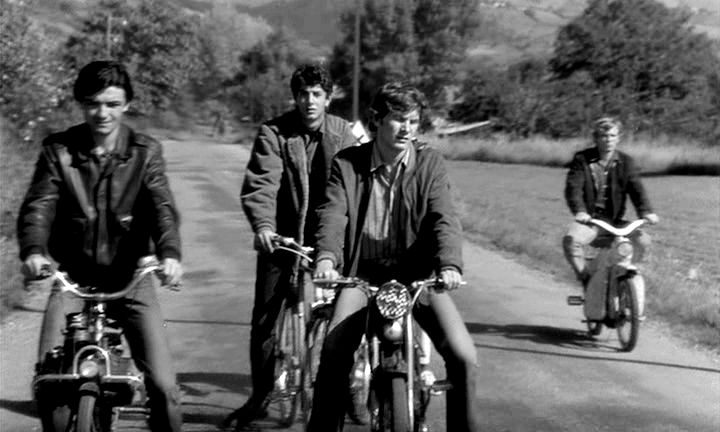
There’s a scene in Robert Bresson’s film Au Hasard Balthazar that completely freaks me out and I’ve thought about it every month or so since I saw the movie.
In the scene, a group of teenage hooligans pours a canister of oil all over a country road, right in the middle of a curve. Shortly after this, they watch a car come down the road and slide off into a ditch or field after hitting the patch of oil. Bresson shows the faces of the boys after seeing the results of their dangerous oil slick shenanigans. What we see is a complete lack of emotion, absolutely nothing, emotional vacuums. The boys aren’t happy, guilty, satisfied, or anything else we can intuit. They seem to acknowledge the incident and simply move on with their day. It absolutely terrifies and intrigues and mystifies me.
Why? Why does it have this powerful effect? Well, the primary answer is probably the most obvious one, which is that as a viewer I expect there to be jubilation or at least a sort of satisfied pride in the fact that their prank worked, that it came to be and happened just as they had hoped and expected it to, a laugh, or an excited rush to run away from their handy work. It’s incredibly jarring to not get this reaction, or any reaction at all. Reality seems to break for a moment. It’s confusing and creates a flood of questions.
The moment is one that breaks through the veil, punches a hole through reality, and for a brief moment it feels like you can see the Truth out of the corner of your eye. This is what great Art can do, baby! This break from the expected, this moment where things become so artificial that they swing back around to real, transforms the characters from “teenage hooligan” archetypes to something bigger and deeper and weirder. They become cogs in a great machine, agents of chaos placed in the universe by god-knows-what or god-knows-who or god itself to sow disharmony. They do this neither gleefully or regretfully. They just know that they are supposed to. They seem to be going through the motions, behaving on instinct that they don’t understand but also don’t question. It seems to be something that just must be done. The way they react to the car crashing is like they way one looks after shutting a light off in a kitchen before going to bed. You’re not “satisfied” or “happy” or “scared” or “excited” by this act. You just acknowledge that you’ve done it and go to bed.
I have no groundbreaking revelations about all of this. I just needed to exorcise the moment that’s been rattling around in my head, and acknowledge the black magic that Bresson was able to tap into. There really is something special about his movies.
 Culture Krud
Leave a comment