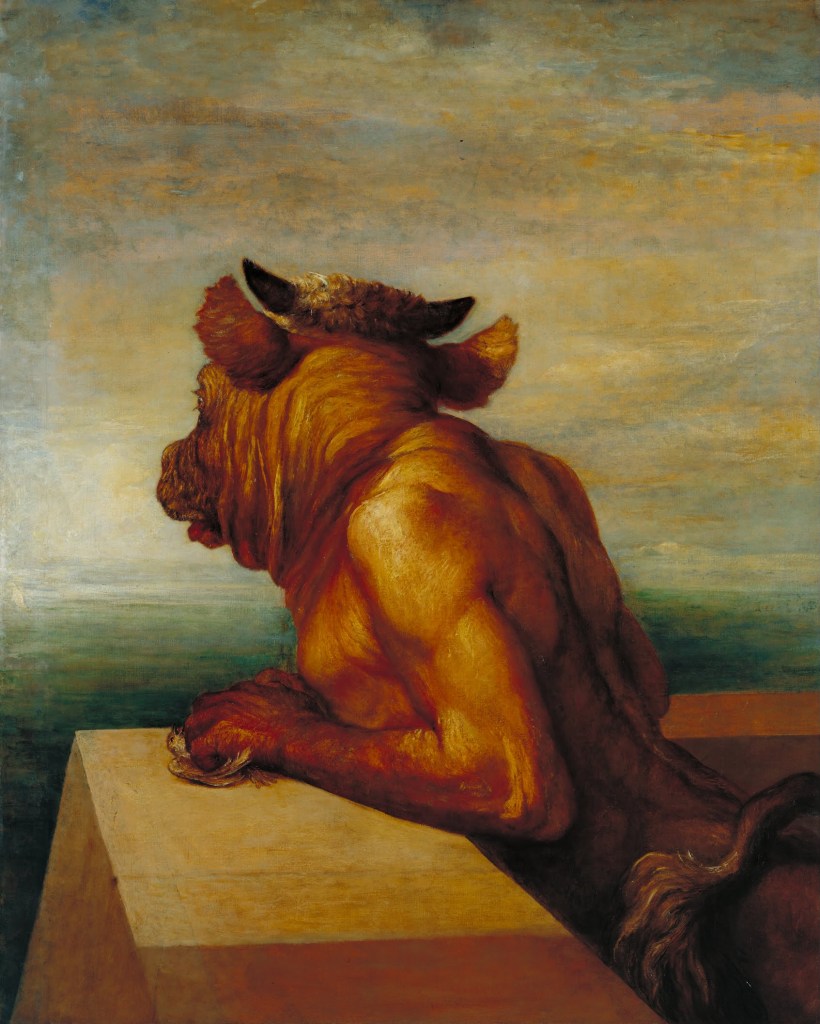
I recently read the Jorge Luis Borges story “The House of Asterion,” which consists of the retelling of the Greek myth of the minotaur from the monster’s perspective. I really liked the story and, as I often do, I looked it up on Wikipedia to get some more information about it. As I searched for the Borges entry, I ran across an entry for the painting The Minotaur by George Frederic Watts. The image really blew me away, and I immediately felt that it shared with the Borges story an empathy with the monster, a humanizing quality, an amoral look at the bullheaded beast. Literally seconds later, I came across a section in the Wikipedia entry that says that Borges was actually inspired to write the story (that I had just read and which inadvertently exposed me to the Watts painting) when he saw the painting in a book. What!? Magical cultural bullshit manifesting itself in real time in my noodle.
One of the most interesting pieces regarding the story and the painting is that, according to the Wikipedia article, the inspiration for the painting was an article about child prostitution that Watts had read. He was understandably bummed out about the situation. The painting was meant as an allegory for the monstrous practice/business and, I suppose, those who both profited from it and those who were paying for it. What is so interesting about this is that he obviously failed miserably in that mission as both Borges and I were taken in by the humanity of the monster. We both saw the painting and felt the suffering and loneliness of the bull headed monstrosity, not the suffering of the humans who were to be sacrificed.
Very quickly, I just want to point out the obvious thing about the painting that makes it so unique and powerful which is the very odd viewpoint or camera angle the painting portrays the image from. If you asked me or most anyone to draw a picture of a minotaur, 99.9% of us would draw the monster from straight on or maybe in profile. It feels absolutely insane to me that Watts decided to paint him from a strange back or rear three quarters view point. It’s like, by showing us the most uninteresting parts of the monster, the image is intensely strange and interesting. We only see tiny parts of an eye and a greatly foreshortened side of the mouth. We get the back of the comically small horns. We get the end of a tail. Most of what we see is the back of a wrinkled neck and the back of a muscular arm. It feels like a stolen moment in a Polaroid, like someone in a photo found in a shoebox at your mom’s house, not a composed painting of a mythical beast. This strange camera angle does something pretty remarkable. It makes us feel like the monster is a real being with thoughts and feelings and an inner life, and this is exactly what Borges’ story explores.
There can be something sort of magical about an artist or author having one intention that gets completely decimated by the work itself. It’s as if the subconscious, intuitive part of Watts didn’t really care what the intellectual part of Watts was going for. Some part of the painter felt for the monster, or at the very least was able to enter into the inner world, inner life of this beast who waits in a labyrinth by himself for years until a group of terrified, desperate people are dumped onto his island, and he kills them without any hate or malice. Time and ignorance has washed away the artist’s intentions, and we’re left with the real shit, the shit that maybe even the artist was unaware he was bringing into the world.
 Culture Krud
Leave a comment